Aerobic treatment systems consist of several processes that work together to provide a high-quality effluent:
- Removal of grass solids (trash)
- Aeration
- Clairification
- Sludge return
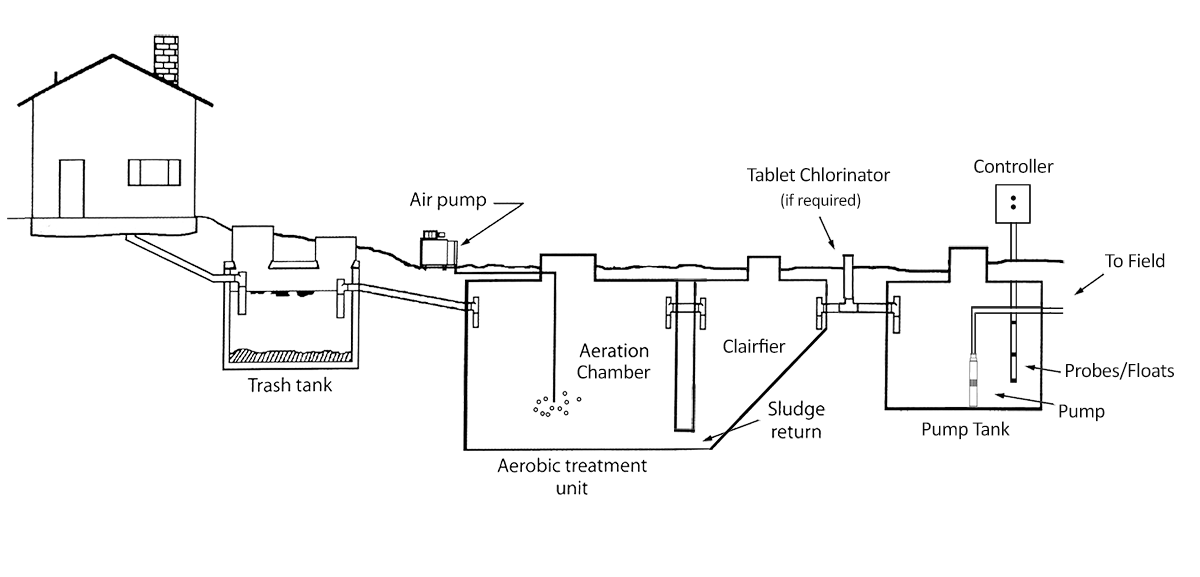
Trash Tank
Wastewater leaves the house through a pipe and enters the trash tank. this is where the heavier solids will settle to the bottom while the lighter materials will float to the surface.
Potiental Issues:
- Tank integrity
- Lid integrity
- Failure of seals around risers, etc.
The wastewater flows from the trash tank into the aerobic treatment unit. Air is pumped into the aeration chamber of the unit, and the wastewater remains there for a relatively long period to allow the microbes to convert the waste into less harmful subtances: water, carbon dioxide, and new cells.
After the aeration process, the effluent now moves into a clarifier, which removes the microbial cells, cell waste, and dead cells from the wastewater. Clarifiers can be oriented vertically or horizontally.
Pump systems areused in many ways in On-site wasterwater treatment systems. For example, the may be used to store and deliver effluent to a spray field or other soil dispersal area.
Pump tanks may also be used earlier in the treatment train to deliver wastewater uphill to a treatment unit. In these applications, the tank may serve as a flow equalization tank.
The pump system consists of a pump tank, pump, discharge assembly, controller, and associated electrical components.
Aerobic treatment systems consist of several processes that work together to provide a high-quality effluent:
- Removal of grass solids (trash)
- Aeration
- Clairification
- Sludge return
Aerobic Systems rely on a continuous supply of oxygen to keep the microbes treating the wastewater heaalthy. Oxygen can be supplied to the wastewater in several ways, including by aerators, compressors and blowers.
Pump systems should include a controller to sense water level in the tank, and dose the field when required, or set off alarms if needed. The control panel can be simple or complex depending on the functions it must perform. Some examples of controller functions are:
- Automatically turning the pump on and off with a manual override.
- Sounding an alarm to indicate problems.
- Providing a means of monitoring the system (meters/counters).
- Electronic monitoring and automatic notifications
- Monitoring the air system and tracking air pressure levels to extend compressor's lifespan and ensure proper treatment.
The solids that settle in the clarifier should be returned to a previous component. Usually the seetled material, or sludge that settles is returned to the aeration chamber via a sloped tank bottom, or pump that returns the sludge to the aeration process.
Sludge return is essential to the treatment process. With sludge return, the microbes in the sludge breakdown additional wastewater and reproduce, increasing the population to replace dying microbes.
Chlorinators (Tablet & Liquid) and UV light systems serve as secondary treatment devices. Tablet Chlorinators are most common.
Tablet Chlorinators typically consist of a long narrow tube that holds tablets, which acts as a dispenser for the tablets into the effluent below.
- More info on chlorinators
